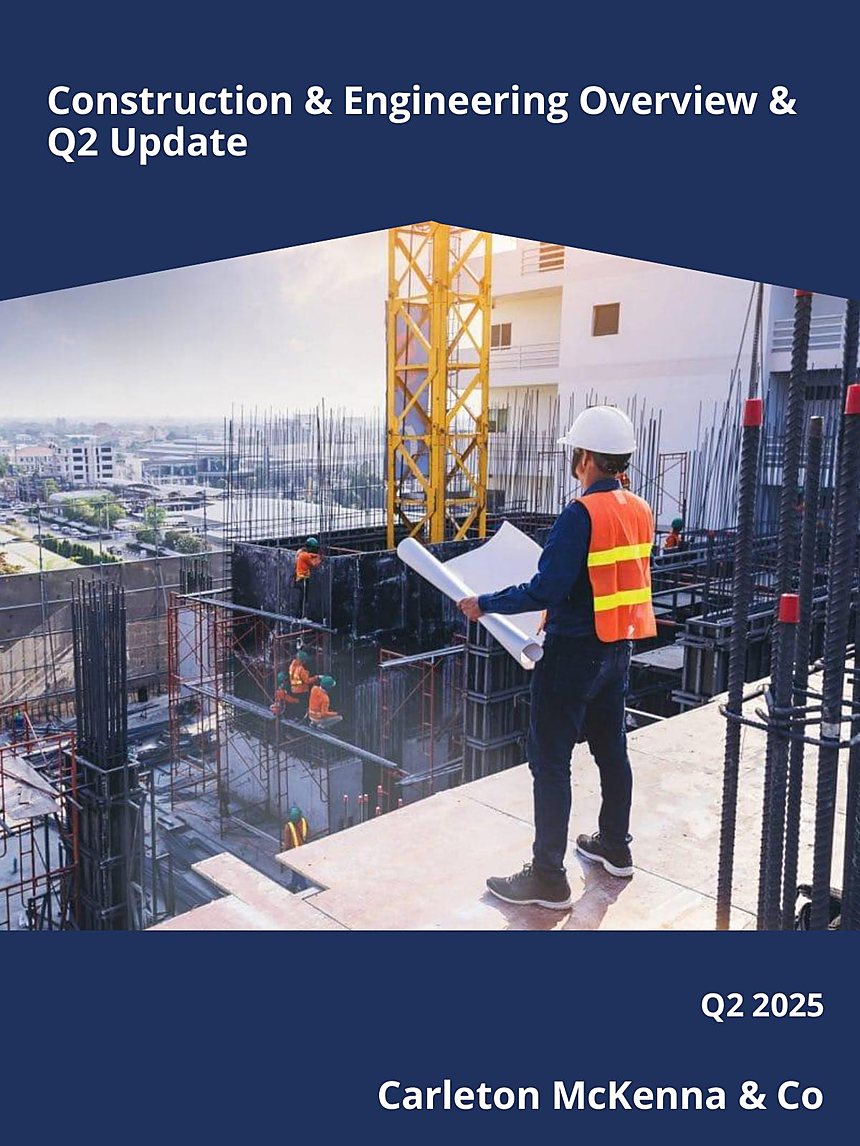
M&A activity in construction and engineering softened modestly in Q2 2025, with 235 announced transactions versus 260 in Q1. Buyers remained selective amid elevated borrowing costs, but a thin supply of quality assets continued to fuel a scarcity premium for well-managed contractors with margin durability, recurring revenue, and visible backlog.
Q2 2025 outlook
Overall activity
Volume dipped modestly to 235 transactions in Q2 2025 versus 260 in Q1, reflecting a measured pace of dealmaking amid persistent capital market uncertainty.
Strategic and financial buyers each accounted for roughly half of total transactions, continuing a balanced mix of acquirer types.
Market dynamics
Strategic acquirers maintained an advantage, supported by stronger balance sheets and less reliance on leveraged financing. Many financial sponsors remained selective, awaiting clearer signals on interest rates and inflation.
Valuations remained stable overall, though buyers showed greater scrutiny of backlog quality, working capital discipline, and exposure to discretionary residential spend.
End-market highlights
Infrastructure and civil construction continue to benefit from federal funding tailwinds tied to the IIJA and IRA, driving elevated demand for contractors with public-sector exposure and self-perform capabilities.
Residential construction remains uneven: contractors with recurring maintenance, renovation, and retrofit work continue to outperform those tied to new-build housing, where affordability challenges persist.
Nonresidential building activity is supported by manufacturing and reshoring investment, particularly in energy, data centers, semiconductors, and logistics.
Carleton McKenna perspective
Buyer conversations in Q2 underscored rising interest in specialty trade contractors, especially electrical, mechanical, and infrastructure-oriented firms with recurring service and maintenance revenue.
Our sale of McClintock Electric, a full-service electrical contractor with a strong service base and institutional client mix, exemplifies sustained investor appetite for margin-durable, labor-secure platforms in the current market.
The macro picture
Total seasonally adjusted U.S. construction spending was consistent year-over-year at a record annual rate above $2.1 trillion. Growth continues to be driven by federally funded infrastructure and industrial manufacturing projects, which have offset slower residential activity. Infrastructure and public works have expanded consistently since 2022, underpinned by the IIJA and IRA, with investments in transportation, utilities, and clean energy creating a strong tailwind for civil and heavy contractors.
Private nonresidential spending is robust, particularly in manufacturing, data centers, logistics, and healthcare, supported by reshoring and energy transition projects. Commercial and office construction continue to lag due to structural changes in occupancy and leasing behavior. Residential spending has stabilized at lower levels after the 2023 correction, with elevated mortgage rates and affordability pressure constraining new housing starts. The industry outlook remains stable to modestly positive, with public and industrial demand anchoring growth through the back half of 2025 and into 2026.
Market trends and outlook
Spending versus the federal funds rate
Spending eased slightly since mid-2024 even as the Fed funds rate stabilized, highlighting the lag between rate shifts and project starts. Developers are finishing work financed under earlier high-rate conditions while new starts remain limited.
The industry is working through backlogs from the 2022 to 2023 surge in public and industrial projects. Private markets remain soft, but infrastructure and manufacturing anchor activity. The dip reflects temporary normalization, not contraction, and spending should recover gradually into 2026.
PPI: construction materials
Input costs climbed sharply from 2019 through 2022, driven by commodity inflation, supply-chain disruption, and fuel volatility. Prices have since plateaued near record levels, remaining roughly 30% above pre-pandemic averages but largely stable through 2025.
This stabilization signals inflation normalization, allowing contractors to improve bid accuracy and margin visibility. While materials remain costly, the absence of volatility has strengthened pricing discipline and project confidence across the sector.
Employment Cost Index: construction
Labor costs have risen steadily since 2019, up roughly 15% to 20% through mid-2025 as skilled worker shortages persist across all trades. Wage growth has moderated since its 2022 peak but remains well above pre-pandemic norms.
Elevated compensation continues to pressure contractor margins, particularly for firms unable to pass costs through in fixed-bid contracts. Contractors with self-perform capabilities and strong retention programs remain best positioned to manage cost inflation and preserve profitability.
Disclosed valuation multiples
Recent disclosed transactions cluster around a median of 7.7x EBITDA on a median enterprise value near $97M, with two outliers (Cupertino Electric at 11.9x on $2.0B and Miller Electric at 10.8x on $865M) excluded from the precedent analysis.
Selected disclosed transactions, 2024 and 2025
Oct-25, Fraser River Pile & Dredge acquired by Bird Construction (TSE: BDT), Nonbuilding (Infrastructure), $20.0M EV, 4.1x.
Sep-25, CEC Facilitate Group acquired by Sterling Infrastructure (NAS: STRL), Nonresidential Building and Infrastructure, $52.5M, 9.6x.
Jul-25, Dynamic Systems acquired by Quanta Services (NYS: PWR), Nonresidential Building, $120.0M, 11.3x.
Mar-25, GeoStructures acquired by ICOP (MIL: ICOP), Nonresidential Building, $126.0M, 7.1x.
Mar-25, Canada's Best Store Fixtures acquired by LSI Industries (NAS: LYTS), Commercial (Retail), $31.0M, 7.8x.
Mar-25, Lionmark Construction Companies acquired by Breedon Group (LON: BREE), Nonbuilding (Infrastructure), $238.0M, 7.7x.
Feb-25, Miller Electric Company acquired by Emcor Group (NYS: EME), Nonresidential Building, $865.0M, 10.8x (outlier).
Aug-24, Jacob Bros Construction acquired by Bird Construction (TSE: BDT), all building types and infrastructure, $97.0M, 3.5x.
Jul-24, Cupertino Electric acquired by Quanta Services (NYS: PWR), Commercial and Infrastructure, $2.0B, 11.9x (outlier).
Residential construction: trends and recent transactions
Housing starts and permits have stabilized at lower but steady levels after the 2022 declines, with builders rate-sensitive and selective. Mortgage rates have more than doubled since 2021 and hover near 7%, sustaining rental and multi-family demand. Skilled labor shortages remain severe; ABC estimates the industry must attract over 430,000 workers in 2025 to meet demand. Multi-family activity holds above pre-pandemic levels, while remodeling and renovation, particularly HVAC, plumbing, and roofing, remain steady and margin-stable.
Deal activity reflects these dynamics. Buyers continue targeting service-based and recurring-revenue contractors in HVAC, plumbing, and renovation, avoiding new-home exposure. PE firms are pursuing bolt-on acquisitions in fragmented trades such as electrical and mechanical, while larger platform deals remain limited by financing costs. Builders and service groups are acquiring subcontractors and suppliers to secure labor, stabilize costs, and improve margin control.
Recent residential transactions, * = PE-backed acquirer
Oct-25, Elite Flooring to Artisent Floors.
Oct-25, Vanderkoy to Installed Building Products.
Oct-25, Apex Fire Protection to Automatic Fire Protection*.
Sep-25, McWilliams Roofing, acquirer undisclosed.
Sep-25, Kenneth Daniel Roofing to Ridgeline Roofing & Restoration*.
Sep-25, Fencecrete America to Lake State Partners*.
Sep-25, J3 Systems to Tecta America*.
Sep-25, RC Legnini to The Byng Group*.
Nonresidential building construction
Federal incentives under the CHIPS and IRA continue to drive reshoring and advanced manufacturing, including semiconductor, EV battery, and clean energy facilities. Spending remains well above pre-pandemic levels, with multi-year backlogs benefiting mechanical and electrical contractors with technical expertise. Healthcare, education, and government facility projects are offsetting softer commercial segments. Office construction remains weak amid 21% vacancy and hybrid-work dynamics; activity concentrates in tenant improvements and adaptive reuse. Sustainability and energy efficiency demand is rising as owners pursue ESG goals and lower operating costs.
Buyer themes track these trends. Acquirers are targeting contractors active in manufacturing, logistics, and data center construction. PE remains focused on mechanical, electrical, and HVAC contractors with recurring service revenue and regional density. Energy-efficient upgrade, retrofit, and LEED capabilities are increasingly prized, particularly among firms with institutional clients.
Recent nonresidential transactions, * = PE-backed
Oct-25, McClintock Electric to Kelso Industries*, electrical contracting for residential, commercial, and industrial projects (Carleton McKenna represented the seller).
Oct-25, Deep South Electrical Contractors to Golden Triangle Ventures.
Oct-25, The Greathouse Company to Roebuck Wholesale Nursery and Landscaping*.
Oct-25, Meisner Electric to Comfort Systems USA (NYS: FIX).
Sep-25, Cypress Construction Management to STV Group.
Sep-25, Lone Star Roofing & Contracting to Noland's Roofing*.
Sep-25, Montgomery Roth to Shive-Hattery.
Nonbuilding construction
The continued rollout of the IIJA and IRA is sustaining elevated activity across transportation, utilities, and clean energy. Investment in highways, bridges, and transit remains robust, though procurement delays and permitting bottlenecks continue to push certain starts into late 2025. Grid modernization and energy transition activity is driving substantial investment in transmission, storage, and resilience. Water and environmental spending continues to rise as municipalities address aging infrastructure and regulatory mandates. Skilled equipment operator shortages and tight procurement for specialized components remain pressure points.
Recent nonbuilding transactions, * = PE-backed
Oct-25, P&S Paving to Construction Partners (NAS: ROAD).
Oct-25, George F Young to Smith Seckman Reid.
Oct-25, Agbara Engineering to WSB & Associates*.
Oct-25, Innerlight Engineering to Pape-Dawson Engineers*.
Oct-25, Fraser River Pile & Dredge to Bird Construction (TSE: BDT).
Oct-25, Gulbranson Services to TAK Communications*.
Sep-25, CE Group to LJA Engineering.
Sep-25, Diefenderfer Electrical Contractors to ArchKey Solutions*.
For the deeper read on electrical contracting specifically, including a Braemont Capital / Loenbro platform case study and our Project Power engagement, see our Q1 2025 C&E update, which features electrical contracting as the spotlight vertical.
← Back to all insights